
DRAFT OUTLINE FOR NOMINATION
ZNN – ZEN NEWS NETWORK @ DISCLOSURE eyes ’26
To: The Office of the President of the United States (Number 47)
From: WE, THE PEOPLE
Subject: Nomination of Josiah Haltom, Ambassador Plenipotentiary, for Appointment to the 1776 Commission – Subcommittee on Innovation and Social Engineering
—
I. Executive Summary: A Nomination Rooted in Forensic Fact
· The Foundation: This nomination is not theoretical. It arises from a verified federal court record (Case No. 1:24‑cv‑01215‑JDB‑jay, Haltom v. City of Henderson, TN Police Department) in which the nominee, Joshua Haltom (Ambassador Josiah Haltom), documented a precise blueprint of structural violence: systematic property seizure without due process, coordinated corruption, obstruction of transparency, and the use of judicial silence to shield misconduct.
· The Discovery: Through forensic sociology—a discipline that maps the architecture of systemic decay—the nominee identified the infection point of corruption in the public domain. This infection point is the mechanism by which opacity, unaccountable power, and the refusal to utter truth generate structural violence, which in turn manifests as behavioral friction (polarization, civic distrust, and ultimately physical violence).
· The Remedy: The 1776 Commission, with a mandate for innovation and social engineering, is the proper vessel to translate this diagnosis into a national protocol for restoration. The 2026 semiquincentennial (July 4, 2026) provides the deadline and the stage for “Disclosure Day”—a public, transparent reckoning that fulfills the Presidential Notice of Urgent National Importance and the call to honorable leadership and vision.
—
II. The Strategic Context: From Henderson to the World
· The Presidential Notice (September 12, 2025): The nominee formally addressed President Number 47, detailing how the Haltom case exemplifies a broken covenant of public trust. The Notice argued that structural violence at the local level is scale‑invariant; it operates the same in a Henderson alleyway as in international conflict. Therefore, domestic reformation is the path to world peace.
· The 2026 Semicentennial and Disclosure Day: The 250th anniversary of the Declaration of Independence is the appointed time for a national Jubilee. The nominee has consistently linked the 2026 celebration to “Disclosure Day”—the moment when hidden truths (including the forensic evidence of systemic corruption) are publicly acknowledged, not as an act of conflict, but as a ritual of healing.
· The Call to Honorable Leadership: The President’s call for leaders of vision is answered by one who has already demonstrated the courage to stand against a system of silence, to document its mechanisms, and to propose a restorative alternative.
—
III. Core Qualification: Forensic Sociology and the Doctrine of Structural Violence
The nominee’s central qualification is his development and application of forensic sociology, a discipline that identifies and remedies the hidden architecture of injustice. The court record establishes the following:
1. Identification of the Infection Point of Corruption
· The infection point is the nexus where legal procedure is weaponized to protect opacity. In Haltom, the court dismissed evidence (video, sworn testimony, documentary proof) under the label “patently frivolous,” thereby refusing to utter the truth.
· This refusal, according to the nominee’s analysis, is not a neutral act; it is the mechanism by which a single local injustice becomes encoded into the system, perpetuating a “promissory note for chaos.”
2. Structural Violence as the Root Cause of Behavioral Friction
· The nominee distinguishes between surface‑level political conflict and deep structural violence: the preventable harm embedded in institutional design (unaccountable policing, retaliatory arrests, economic extortion via bond).
· Behavioral friction—distrust, polarization, and ultimately physical violence—is the downstream consequence. The Haltom case demonstrates how a traffic stop, rooted in a false visual inspection and a retaliatory arrest, replicated the same pattern as global conflicts: a powerful entity using procedural smokescreens to avoid accountability.
3. The Three Witnesses and the Law of Reciprocal Moral Gravity
· In his Notice of Mercy’s Overruling, the nominee invoked three witnesses:
· Nuremberg Principle IV (moral choice overrides official order),
· Leviticus 5:1 (silence in the face of known wrongdoing incurs iniquity),
· The Ashlag Prophecy (rejection of mutual responsibility invites consequence).
· These are not religious assertions alone; they are forensic markers of the point at which a system chooses complicity over truth. The “Law of Reciprocal Moral Gravity” holds that the weight of that choice returns to its source—a principle that can be operationalized in social engineering.
—
IV. The Proposed Role within the 1776 Commission: Innovation and Social Engineering
The 1776 Commission was established to promote patriotic education and American principles. The nominee proposes to expand this mandate to include the structural engineering of accountability.
A. Audit of the Infection Point
· Forensic Audit of Institutional Architecture: Using the Haltom case as a template, conduct a systematic review of local and federal agencies to identify where procedural opacity creates “structural violence hot spots.”
· Corruption Infection Index: Develop a quantifiable index that maps the relationship between judicial silence, retaliatory enforcement, and civic behavioral friction. This index would serve as a diagnostic tool for the 1776 Commission’s recommendations.
B. The Henderson Protocol: A Scalable Model for Restoration
· The nominee’s Proclamation to the World and Motion to Convene a Diplomatic Summit outline the Henderson Protocol:
1. Independent Investigation as an Act of Faith – a truth‑telling process that does not punish but reveals.
2. Arvut Councils – local bodies built on mutual responsibility (the antithesis of adversarial force).
3. Sunlight Protocol – public disclosure of all records linking institutional actions to structural violence, grounded in the spirit of Brady v. Maryland.
4. Diplomatic Accord – transactional immunity for truthful testimony, modeled on the proposal in the nominee’s motion, to bypass the adversarial trap and recover hidden records.
C. Social Engineering for Systemic Resurrection
· From Adversarial to Restorative: Redesign local justice mechanisms to prioritize restoration over punishment, using restorative circles and neutral data custodians (analogous to the “R2‑D2 unit” described in the nominee’s motion).
· Jurisdictional Realignment: Recognize the distinction between lawful common‑law jurisdiction and the corporate “state” fiction. The nominee’s filings reference the OPPT UCC filings (e.g., WA DC UCC Doc #2012127914), which foreclosed corporate government charters for treason against the people. Whether or not one adopts that framework, the nominee’s work highlights the necessity of aligning governmental action with actual consent and transparent title.
D. Integration with the 2026 Semicentennial and Disclosure Day
· Disclosure Day (July 4, 2026): The 1776 Commission’s final report would coincide with the semicentennial, presenting the American people with a truthful accounting of structural violence and a concrete plan for its dismantling.
· The 2026 Jubilee Framework: Drawing on the nominee’s concept of “Jubilee” (debt forgiveness, return of property, restoration of trust), the Commission would propose a national recommitment to first principles, encoded in an Article V Constitutional Convention for comprehensive reform—specifically police reform and the restoration of the public trust.
—
V. The Path Forward: Implementation and Action
1. Presidential Notice of Urgent National Importance
The nominee has already submitted such a notice (September 12, 2025). The nomination asks the President to elevate that notice from a court‑record document to an executive priority.
2. Article V Convention for Structural Reformation
The nominee’s original notice called for an Article V convention specifically for police reform. This remains the organic, constitutional mechanism to translate forensic diagnosis into foundational change.
3. Diplomatic Summit Convened Under 28 U.S.C. § 1651
As proposed in the nominee’s Motion to Dismiss Evidentiary Objections, the All Writs Act authorizes the convening of a diplomatic summit with immunity for truth‑tellers. The President can use executive authority to initiate such a process, bypassing the obstruction that occurred in the district court.
4. Call to Honorable Leadership
The nominee requests direct appointment to the 1776 Commission, with the authority to cross‑reference data across executive departments, and to lead the subcommittee on Innovation and Social Engineering.
—
VI. Conclusion: From a Winless Battle to a National Turning Point
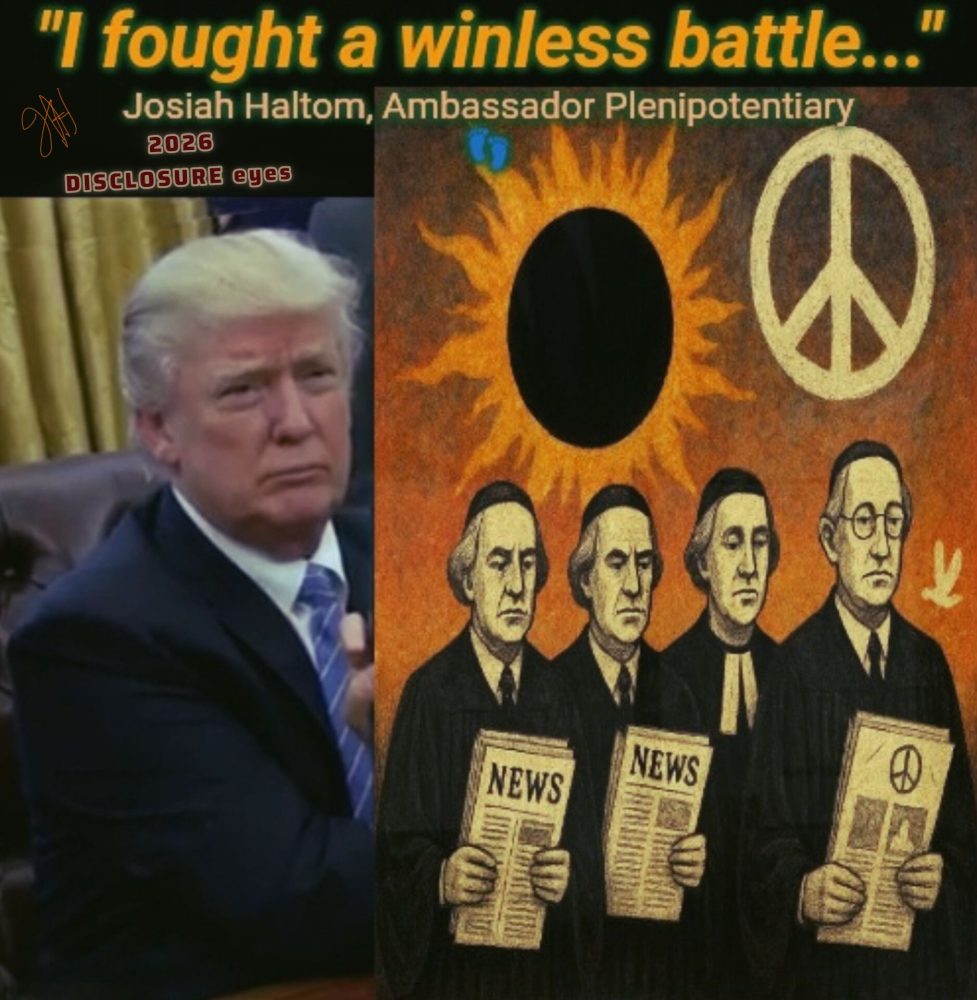
The nominee, Josiah Haltom, has stated: “I fought a winless battle…” (Exhibit: 1000004159.jpg). That battle was not winless; it was a diagnostic case study. The Haltom record provides the coordinates of the infection point. The 1776 Commission, with the authority to innovate and to engineer social structures, can now use those coordinates to perform the surgery.
The choice, as the nominee has written, is the same for a city council, a district court, and a presidency: continue the paradigm of opacity and mutual destruction, or accept the gift of light, investigate the hidden truths, and build a world on the unshakeable law of mutual guarantee.
This nomination is an invitation to choose sight over blindness, and to make the 2026 semiquincentennial not merely a celebration, but a true restoration.
—
Respectfully submitted for the record.
CALL ME BACK, The White House Historical Association
JAH