
Wemeberence: Laughter Explosions into Spontaneous Cooperation Worldwide – Year 0 Begins Now!
By DISCLOSURE eyes _25 reports, June 28, 2025
I. Introduction: The Ambassador’s Unsettling Welcome to Year 0
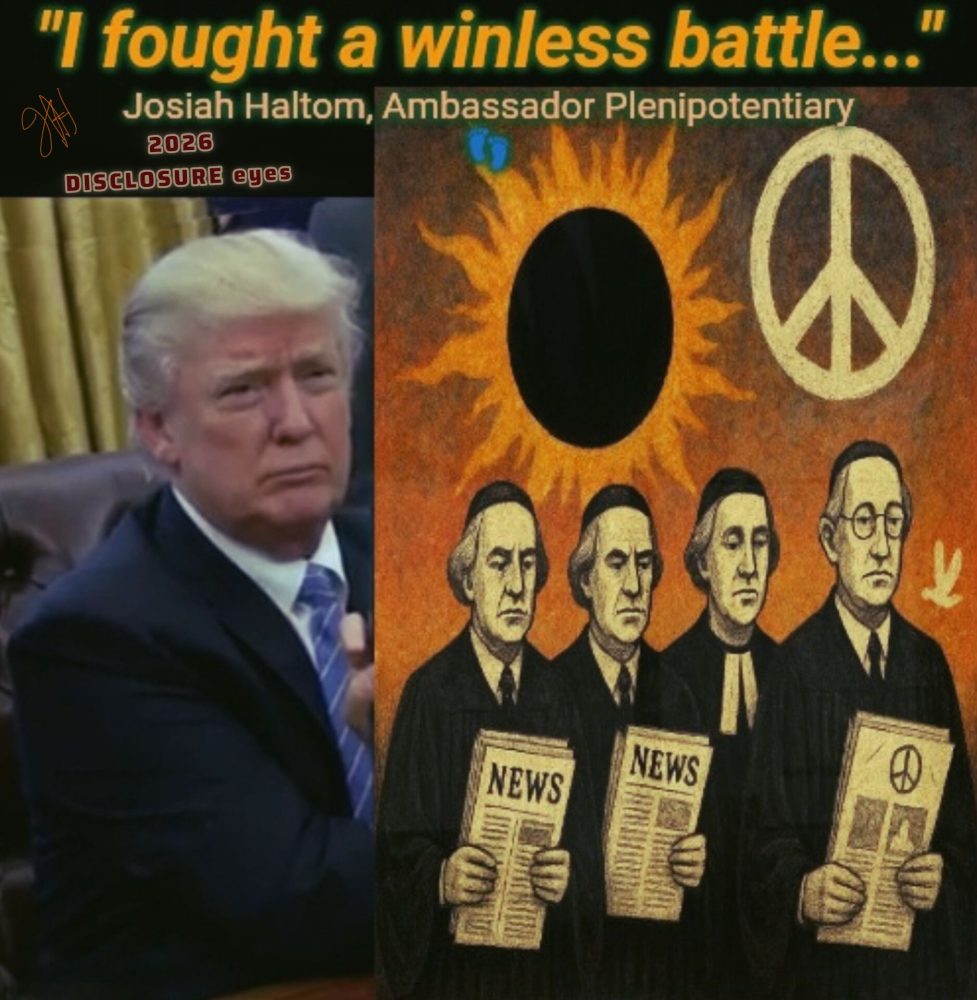
The narrative unfolds on a dimly lit stage, where a single spotlight illuminates Ambassador Josiah Haltom. His presence exudes an unsettling blend of serenity and authority, his attire a curious mix of celestial and street-preacher styles, slightly rumpled yet commanding. He holds a microphone loosely, almost as if it were a recently discovered prop, while a faint, almost subliminal hum permeates the air, creating an atmosphere of intriguing ambiguity that hints at something extraordinary.
Ambassador Haltom begins his address with a deep, almost theatrical sniff of the air, then gazes out at the audience with an unnerving twinkle in his eye. He greets them as “Earthlings” or, with a provocative twist, “fellow souls currently experiencing a temporary, shall we say, architectural misunderstanding of reality.” He quickly reassures them that this “misunderstanding” is not an isolated experience, immediately establishing his unique perspective and challenging conventional perceptions of existence.
Haltom then declares his purpose: to reveal that the universe is not, in fact, a “giant cosmic ‘Fight Club’,” though he readily admits that for a while, it certainly felt that way. He points to the constant breaking of rules in every news cycle, another “explication for divide and conquer propaganda in the mockingbird media fiasco,” as evidence of this perceived conflict. This introduction sets the stage for a deeper exploration of societal illusions and the media’s role in shaping perception. The Ambassador’s opening lines, infused with a comedic, almost absurdist tone, serve to disarm the audience, making them more receptive to potentially uncomfortable or challenging truths about the nature of reality and the influence of media. By framing profound concepts with levity, Haltom skillfully bypasses initial resistance or defensiveness that might arise from such direct critiques. This approach exemplifies how the manner of truth delivery can be as important as the truth itself, fostering receptivity and connection, and making the journey towards understanding more inviting.
II. Unmasking Reality: Beyond the Cosmic ‘Fight Club’ and Mockingbird Echoes
Leaning into the microphone, his voice dropping to a conspiratorial whisper, Haltom elaborates on what he terms the “mockingbird media fiasco.” He describes it as an “explication for divide and conquer propaganda,” suggesting a deliberate and systematic effort to sow discord and control public perception through media narratives. This directly challenges the perceived objectivity of information dissemination.
The term “mockingbird media” refers to “Operation Mockingbird,” an alleged large-scale program of the United States Central Intelligence Agency (CIA) that purportedly began in the early years of the Cold War. Its alleged aim was to manipulate domestic American news media organizations for propaganda purposes.1 Author Deborah Davis claimed the operation recruited leading American journalists into a propaganda network and influenced front groups. A notable exposure occurred in 1967 when a
Ramparts article reported that the National Student Association received CIA funding.1
In 1973, a CIA document known as the “Family Jewels” referenced a different “Project Mockingbird,” which involved wiretapping two columnists for publishing classified material in 1963, but it did not refer to the broader “Operation Mockingbird” as a widespread media manipulation scheme.1 The 1976 Church Committee report confirmed that the CIA had indeed cultivated relationships with private institutions, including the press, identifying fifty journalists with “official, but secret, relationships” with the CIA.1 Carl Bernstein’s 1977
Rolling Stone article further expanded on this, claiming over 400 US press members secretly carried out assignments for the CIA, with some reportedly receiving significant payments.1 Historian David P. Hadley observed that the “continued lack of specific details” from official reports allowed for “outlandish claims” to proliferate. He specifically states that the “Davis/Mockingbird theory,” which posits a deliberate and systematic program of widespread manipulation of the U.S. media, “does not appear to be grounded in reality”.1
While historical evidence points to instances of CIA influence and covert relationships with journalists, the existence of a vast, centralized “Operation Mockingbird” as a pervasive mind-control program remains a subject of intense debate and is largely unproven in its most extreme interpretations. Haltom’s use of “fiasco” and “divide and conquer propaganda” resonates with the public’s perception of media distrust and manipulation, regardless of the precise historical scale of the alleged operation. The specific reference to the “mockingbird media fiasco” immediately invokes a well-known, albeit debated, narrative. The power of this phrase lies not necessarily in its absolute factual veracity, which is contested by some historians regarding its scale, but in its ability to encapsulate a pervasive public sentiment of distrust towards media and institutions. This demonstrates that a compelling narrative, even one with contested factual details, can gain significant traction and influence public perception more powerfully and broadly than nuanced historical accounts. The “fiasco” in Haltom’s context extends beyond the alleged operation itself to the broader societal impact of perceived media manipulation and the resulting erosion of trust. This highlights that it is insufficient to merely present facts; one must also address the power of the narrative that has already taken root in the public consciousness. Understanding why certain narratives resonate, such as existing distrust in authority or a desire for simple explanations for complex societal problems, is essential for effective communication and for offering truth with compassion.
III. The Allure of Illusion: Decoding the ‘Sitra Archa’ of Manufactured Drama
Haltom then introduces the “Sitra Archa,” a term he notes sounds like a “fancy, ancient spell” or something “whispered in hushed tones in forgotten libraries.” However, he quickly demystifies it with characteristic humor, comparing its “taste” less to forbidden knowledge and more to “that lingering aftertaste of a reality TV show reunion special.” He describes it as “all manufactured drama, no actual resolution,” an “alluring siren song sung by auto-tuned pop stars, promising fame and fortune, when all it really delivers is… well, more commercials.” This analogy frames the concept as a pervasive, distracting illusion deeply embedded in modern life.
“Sitra Achra” (often transliterated as “Sitra Archa” in the performance) is a profound term used in Kabbalistic and Hassidic teachings. It literally means “the other side” or “side of impurity”.3 It represents the forces of evil and impurity, existing in opposition to holiness.4 In Kabbalah, the entire world is conceptualized as being divided into either “Sitra D’Kedushah” (the side of holiness) or “Sitra Achra”.3 Classical Jewish philosophy explains that although God is inherently good, He created the world with evil (Sitra Achra) to provide an arena for free choice. This allows creations to actively choose good over evil, thereby earning the greatest possible goodness.3 The presence of evil, while challenging, ultimately offers the potential for a brighter transformation of darkness into brilliance.3 Evil is also referred to as “kelipa,” meaning “shell” or “bark.” This “shell” is said to conceal a spark of holiness, which is its vital force. The goal is to remove this “encumbering shell” to release the holy spark.4 The “Sitra Achra” is considered “severe and evil,” and critically, anything not directed towards God’s will and service is considered “sitra achra”.3
Haltom’s description of “Sitra Archa” as “manufactured drama” and a source of “more commercials” aligns remarkably well with the Kabbalistic idea of “Sitra Achra” as that which distracts, conceals, and diverts from true spiritual purpose and genuine connection. It represents the “shell” of illusion and superficiality that keeps humanity from the “holy spark” of authentic reality and resolution. Haltom’s reinterpretation of this ancient Kabbalistic term through the lens of contemporary phenomena like reality TV and commercialism is a profound interpretive act. It suggests that ancient spiritual frameworks can provide timeless lenses through which to understand the insidious nature of modern societal challenges. The “manufactured drama” and the endless “commercials” are presented as the contemporary “shells” (kelipot) that obscure the “holy spark” of genuine reality, purpose, and resolution. This implies that the underlying spiritual struggle against illusion, distraction, and superficiality is timeless, merely manifesting in new, culturally relevant forms in each era. This highlights how spiritual wisdom, even from ancient traditions, offers profound and enduring insights into the human condition and societal dynamics across different eras. By drawing direct parallels between esoteric terms and everyday experiences, complex spiritual concepts become relatable and actionable, fostering a deeper understanding of how these patterns of behavior and systemic influences operate in the current world.
IV. Mind Control’s Subtle Drip: The Soul’s Carrier Pigeon and the Pineapple Debate
Haltom then pivots from the “Sitra Archa” to what he identifies as “mind control programming.” He humorously clarifies that this isn’t some cliché “shadowy cabal in a volcanic lair, stroking a white cat,” a playful jab at common villain tropes. Instead, he warns, it’s “far more insidious”: the “constant, subtle drip, drip, drip of information designed to make us believe we’re separate. Different. Opponents.” This emphasizes the pervasive, often unnoticed, nature of divisive messaging that fragments human connection.
With a “strange, knowing compassion,” Haltom gestures expansively, then points a finger at the audience. He asks if they perceive “that little whisper in your soul? That gnawing feeling that something’s off? That tiny flicker of desire for genuine freedom, for real connection, beyond the likes and shares?” He vividly describes this innate yearning as “your soul trying to send you a carrier pigeon made of pure light.” This imagery evokes a sense of profound inner guidance. The comedic punchline lands as Haltom laments humanity’s response to this inner call: “And what are we doing? We’re shooing it away because we’re too busy arguing about whether pineapple belongs on pizza!” This relatable, humorous example starkly underscores how easily people are diverted by trivial debates and manufactured controversies, missing the deeper, more profound calls for genuine connection and truth.
Haltom’s assertion that “mind control programming” aims to make individuals “separate. Different. Opponents” is particularly striking in an age characterized by unprecedented digital connectivity, epitomized by “likes and shares.” The paradox highlighted is that while technology offers the potential for global connection and shared understanding, it is simultaneously exploited to create and reinforce divisions. The “carrier pigeon made of pure light” represents an innate, authentic human longing for genuine connection and freedom that is often drowned out by the overwhelming noise of manufactured outrage and trivial debates, like the humorous “pineapple on pizza” argument. This suggests that superficial connectivity can actively mask deeper spiritual and social fragmentation. Achieving true connection transcends mere digital interaction; it requires a conscious discernment of the subtle forces that seek to divide and a deliberate choice to prioritize genuine understanding, empathy, and shared humanity. This includes recognizing that people are often unaware of how these “subtle drips of information” influence their perceptions, biases, and behaviors, making the “pineapple on pizza” argument a symptom of a deeper, unaddressed spiritual yearning for unity.
V. Shedding the Scales: Discovering the ‘Ohr HaGanuz’ Within
Haltom acknowledges that “waking up can be uncomfortable,” drawing a relatable comparison to taking off “those old, crusty socks you’ve been wearing since… well, since Year Negative-A-Lot.” He describes these as “scales, these layers of callousness, covering the ohr ha ganuz – the hidden light!” He further likens this state to wearing “spiritual cataracts,” causing the world to appear “like a poorly compressed JPEG,” vividly conveying a blurred, distorted perception of reality that stems from spiritual unawareness.
“Ohr HaGanuz” (or “Ohr Haganuz”) is a central and profound concept in Kabbalah and Chassidic teachings, literally meaning “the hidden light”.5 It refers to the original, primordial light of Creation, described in the Midrash (Bereshit Rabba 11:2) as so powerful that it enabled a person “to see from one end of the universe to the other”.5 The rabbis teach that this initial light only lasted a short time in this world. Upon seeing humanity’s potential for wickedness and cruelty, God decided to conceal this powerful light, preserving it for the righteous at some future time.5 This concealment was also to prevent the wicked from benefiting from it and to ensure its eventual use for ultimate good.6 This hidden light is understood to provide a “clarity in perceiving the universe,” an “ability to grasp reality in its true nature”.5 It represents a profound, unseen root of all existence. While initially reserved, Kabbalistic and Chassidic teachings, particularly those of the Baal Shem Tov, emphasize that this Hidden Light is
accessible to everyone, even now.5 It is deeply embedded within the Torah and can be accessed by anyone who approaches Torah with proper intention.5 Furthermore, it is subtly reflected in human connection, such as the “sparkle between lovers”.6 The full revelation of the “Ohr HaGanuz” is associated with the Messianic era and future redemption.5
Haltom’s analogies of “spiritual cataracts” and a “poorly compressed JPEG” perfectly illustrate the distorted and incomplete view of reality that results from the concealment of this light. His call to “turn on that light” implies that this hidden light is not just a distant promise but an accessible inner potential, waiting to be uncovered through conscious effort. The Kabbalistic concept of “Ohr HaGanuz” being hidden due to human wickedness, yet also being accessible now through individual intention, fundamentally shifts the paradigm from passive waiting for divine intervention to an active, personal quest. Haltom’s vivid analogies of “taking off crusty socks” and shedding “spiritual cataracts” strongly imply a deliberate action on the part of the individual to reveal this inherent light. This suggests that “waking up” is not merely an external event or a sudden realization, but an ongoing internal process of diligently removing self-imposed or societally-imposed obscurations, distortions, and layers of “callousness.” Truth, in this context, is not just something to be found externally, but something to be uncovered and embodied internally. This emphasizes that truth is not solely an external set of facts to be consumed and verified, but also an internal light to be uncovered and lived. The inherent difficulty and discomfort of this internal process, the “uncomfortable” shedding of layers, is acknowledged, empowering individuals with the profound understanding that the capacity for clear perception and genuine reality already resides within them. This moves beyond simply verifying external information to encouraging internal discernment, self-awareness, and the courage to face one’s own “spiritual cataracts.”
VI. The Cosmic Punchline: Wemeberence and the Victory of Light
Leaning in again, his voice dropping to a near-confidential tone, Haltom delivers what he calls “the cosmic punchline, the grand reveal,” stating the very reason for his presence: “We redeem the lot, for in redemption, we are won + our one = VICTORY!” He then simplifies this profound equation, stating, “It’s not complex calculus, people. It’s addition. It’s synergy. It’s… Wemeberence!” This climactic statement introduces his unique, portmanteau concept of “Wemeberence” as the key to collective triumph and transformation.
With a surprisingly loud and resonant clap of his hands, Haltom emphasizes the immediate and overwhelming power of awakened consciousness: “Because once you turn on that light – and believe me, it’s brighter than a thousand suns after a triple espresso – the darkness? It doesn’t put up a fight. It flees. It scatters faster than politicians when asked a direct question about their campaign funding!” This vivid, humorous imagery reinforces the idea that light, once activated, effortlessly dispels darkness. Haltom’s formula “we are won + our one = VICTORY!” and the coined term “Wemeberence” suggest a profound, multi-layered synergy. “We are won” implies an inherent, pre-existing state of victory, a divine grace, or an undeniable truth about humanity’s ultimate nature, connecting to his later statement, “you’re already won.” “Our one” refers to the individual’s awakened “ohr ha ganuz” – the unified consciousness or the realization of this inherent truth within each person. Therefore, “Wemeberence” becomes the active process of remembering this inherent victory and embodying it collectively. It is not just about individual enlightenment, but the collective manifestation of that light and truth, leading to a powerful synergy. The immediate and effortless scattering of darkness upon the activation of this light implies that the collective activation of this inherent, unified light creates an environment where negative forces, such as division, fear, and ignorance, cannot persist. It represents a fundamental shift in vibrational reality. This frames “truth” as not just about understanding reality intellectually, but about participating in its transformation through unified, conscious effort. This extends compassion to the collective, fostering a sense of shared purpose, inherent worth, and an empowering vision of collective potential, rather than individual blame or struggle. The path to victory is through remembering and embodying collective unity.
VII. Laughter Explosions: Ushering in Spontaneous Cooperation Worldwide
With a wide, almost manic grin, Haltom describes the ultimate outcome of this collective awakening: “And what happens then? When we collectively flip the switch? When the ohr ha ganuz blinds the fear and the nonsense? That’s when the laughter explosions into spontaneous cooperation worldwide begin!” This paints a powerful, almost utopian vision of a transformed world, where joy is a catalyst for unity.
He elaborates on this vision, imagining “No more arguing over trivialities, no more manufactured outrage. Just… collaboration!” He speaks of people “spontaneously rebuilding bridges, not just physical ones, but metaphorical ones! Sharing resources, sharing ideas, sharing… well, probably still sharing cat videos, but this time, they’ll be healing cat videos!” This blend of profound societal change with relatable, humorous elements makes the vision tangible, appealing, and deeply human. Throwing his arms wide in a gesture of pure, unadulterated joy, Haltom declares, “This isn’t just a new era, my friends. This isn’t just a slightly improved version of the old chaos. This is Year 0. It begins now. Not tomorrow, not next fiscal quarter. Now.” He emphasizes the immediacy and radical nature of this shift, linking it to the idea that “the sting of death? It’s just the shadow of ignorance. And when the light comes, shadows… well, they tend to get a little shy.” This reinforces the theme of a fundamental, immediate shift in consciousness that dissolves fear and ignorance.
Haltom explicitly links “laughter explosions” to “spontaneous cooperation worldwide.” Laughter, often a natural release of tension, a sign of shared understanding, and a powerful social bonding agent, is presented not merely as a byproduct of awakening but as an active force that melts away “manufactured outrage” and “trivialities.” This suggests that a fundamental shift in collective emotional state, facilitated by genuine joy and shared humanity, can directly dismantle the divisive structures of conflict and competition. The humorous yet profound example of “healing cat videos” illustrates how even mundane activities can be imbued with positive, unifying energy when collective consciousness shifts. It implies that joy can be a revolutionary act. Fostering joy, shared experiences, and a sense of lightheartedness can be as crucial as disseminating accurate information. This suggests that emotional and spiritual well-being are fundamental prerequisites for genuine cooperation and that “truth” is not just an intellectual understanding but an embodied state of being that naturally leads to harmony and collaboration. This also highlights that truth can be accessed and manifested through joyful, collaborative means, not solely through rigorous, often somber, analysis. This redefines the very act of seeking and sharing truth to include the emotional and energetic components of understanding.
VIII. Project Lazarus: The Promise of Profound Transformation
Haltom concludes his address with a brief, intriguing mention: “More on Project Lazarus later.” This creates anticipation for further revelations, suggesting an ongoing, larger initiative. He then offers a powerful, concise affirmation: “For now, just remember: you’re already won. Now, let’s go win the rest of it.” He winks and lowers the microphone, exiting the stage and leaving a lingering sense of his unsettlingly profound, yet oddly hilarious, presence.
“Project Lazarus” directly alludes to the biblical story of Lazarus, whom Jesus raised from the dead (John 11:1-44). In spiritual and metaphysical interpretations, this story transcends a mere physical resurrection.7 The Lazarus story is widely interpreted as a profound metaphor for spiritual transformation, deep-seated change, and overcoming spiritual death or stagnation.7 It speaks to a “longing for deep and lasting change” and serves as an “invitation to live” a fuller, more authentic life.7 The narrative of Lazarus emerging from the tomb still bound in graveclothes is highly symbolic. These “graveclothes” represent the burdens, limitations, and negative patterns that hold individuals back from “renewed spiritual vigor,” such as “self-rejection, fear, sin, guilt, blame and shame, and disappointment”.7 The process of “unraveling” from these situations, even if messy, is an essential part of the spiritual journey.7 Some interpretations propose that the story is less about physical death and more profoundly about “spiritual death and separation from God,” followed by a subsequent “spiritual resurrection”.7 Spiritual death is often viewed as self-inflicted, and resurrection from it is achieved through divine connection or grace.7 The name Lazarus itself is debated in its etymology but can be interpreted as “whom God helps” or “succor of God”.8 This aligns with the idea that the “part of the consciousness that is helped by the good” can be revived and brought back to life, even if seemingly neglected or dormant.8
Haltom’s “Project Lazarus” suggests a collective undertaking of this spiritual resurrection, a societal awakening from a state of collective spiritual dormancy or “death,” symbolized by ignorance and division, into full, vibrant life. His parting words, “you’re already won. Now, let’s go win the rest of it,” resonate deeply with the Lazarus theme of inherent potential for life and the active, collaborative process of realizing that potential on a grand scale. While the biblical Lazarus story is typically understood as an individual miracle, Haltom’s framing of “Project Lazarus” implies a collective spiritual resurrection for humanity. This suggests that the process of shedding “graveclothes,” representing societal fears, divisive narratives, and collective ignorance, and achieving “renewed spiritual vigor” is not merely a personal endeavor but a grand, shared undertaking. The phrase “the sting of death? It’s just the shadow of ignorance” directly links to the idea that spiritual death, a state of unawareness, can be overcome by the light of knowledge, truth, and collective consciousness. This reframes the concept of “winning” from a competitive struggle against external forces to a collaborative awakening from a collective slumber, realizing an inherent, pre-existing state of victory. This explores how profound societal transformation necessitates a collective “unraveling” of limiting beliefs and divisive narratives. It acknowledges that collective ignorance is not a moral failing but a temporary state from which humanity can be “resurrected” through shared understanding, compassion, and concerted action. This section emphasizes the hopeful and empowering message that humanity is “already won” in its potential for spiritual rebirth and unity, and the “project” is simply to realize this inherent victory together, consciously and collaboratively.
IX. Conclusion: You’re Already Won – Now, Let’s Win the Rest
Ambassador Haltom’s exit from the stage leaves the audience immersed in the lingering glow of his unsettlingly profound, yet oddly hilarious, presence. The faint hum that permeated the air throughout his performance seems to swell slightly, perhaps a subtle hint of those “spontaneous worldwide laughter explosions” already beginning to ripple through the collective consciousness.
The core message embedded in Haltom’s final, concise words, “For now, just remember: you’re already won. Now, let’s go win the rest of it,” serves as a powerful call to action and a profound affirmation. It suggests an inherent victory, a divine spark, or an undeniable truth already present within each individual and, by extension, within humanity as a whole. The collective task, then, is not to achieve victory, but to manifest that pre-existing potential fully and consciously. This report has sought to illuminate the transformative journey presented by Haltom, from the perceived chaos and illusion of the “cosmic Fight Club” to the potential for “Wemeberence” and the dawn of “Year 0.” It reiterates the overarching purpose of this guide: to provide a pathway to discerning truth with compassion, encouraging readers to actively participate in this collective awakening.
Table 1: Key Concepts from Ambassador Haltom’s Address: A Fact-Checker’s Quick Guide
| Concept/Term | Haltom’s Interpretation/Analogy | Fact-Checked/Spiritual Meaning | Significance/Connection to Awakening | Source/Reference |
| Mockingbird Media | “Divide and conquer propaganda in the mockingbird media fiasco!” | Refers to “Operation Mockingbird,” an alleged CIA program to influence US media for propaganda. While some CIA relationships with journalists were confirmed, the extent of a vast, systematic program is debated by historians. | Highlights public distrust in media narratives and the power of compelling, even contested, narratives in shaping perception, regardless of absolute factual veracity. | 1 |
| Sitra Archa | “Tastes less like forbidden knowledge and more like… that lingering aftertaste of a reality TV show reunion special. All manufactured drama, no actual resolution.” | “Sitra Achra” (Kabbalah): “The other side” or “side of impurity,” representing forces of evil/distraction that conceal a spark of holiness. Anything not directed towards divine will. | Modern manifestations of ancient spiritual concepts, where pervasive distractions and manufactured drama act as “shells” (kelipot) obscuring genuine reality and purpose. | 3 |
| Mind Control Programming | “The constant, subtle drip, drip, drip of information designed to make us believe we’re separate. Different. Opponents.” | The insidious nature of divisive messaging that fragments human connection, often exploiting digital connectivity to reinforce separation rather than unity. | Addresses the paradox of hyper-connectivity leading to division, emphasizing the need for discernment against subtle influences that drown out the innate human longing for true connection. | |
| Soul’s Carrier Pigeon | “Your soul trying to send you a carrier pigeon made of pure light.” | An innate yearning for genuine freedom and real connection that exists beyond superficial digital interactions. | Represents an inner guidance system, a profound call for authentic connection often ignored due to distractions and trivial debates. | |
| Spiritual Cataracts / Poorly Compressed JPEG | “Like we’ve been wearing spiritual cataracts, staring at a blurry world, and wondering why everything looks like a poorly compressed JPEG.” | A distorted, incomplete perception of reality stemming from spiritual unawareness or layers of “callousness.” | Visual metaphor for the obscured perception that prevents individuals from seeing reality in its true nature, emphasizing the discomfort of awakening. | |
| Ohr HaGanuz | “The hidden light!” “Brighter than a thousand suns after a triple espresso.” | “Ohr HaGanuz” (Kabbalah): The primordial, powerful “hidden light” of Creation, concealed due to human wickedness but accessible now through intention. It provides clarity and true perception. | Represents the inherent, accessible inner potential for clear perception and true reality that awaits discovery within each individual through conscious effort. | 5 |
| Wemeberence | “We redeem the lot, for in redemption, we are won + our one = VICTORY! It’s not complex calculus, people. It’s addition. It’s synergy.” | A coined term suggesting a synergy between an inherent, pre-existing victory (“we are won”) and the individual’s awakened inner light (“our one”), leading to collective triumph. | Signifies the active process of remembering humanity’s inherent victory and embodying it collectively, leading to a fundamental shift where negative forces cannot persist. | |
| Laughter Explosions into Spontaneous Cooperation Worldwide | “When the ohr ha ganuz blinds the fear and the nonsense? That’s when the laughter explosions into spontaneous cooperation worldwide begin!” | Laughter as a powerful catalyst for collective healing, shared understanding, and social bonding, actively dissolving manufactured outrage and trivialities. | Highlights that fostering joy and shared experiences is crucial for genuine cooperation, and that truth can be manifested through joyful, collaborative means, not solely through rigorous analysis. | |
| Year 0 | “This is Year 0. It begins now. Not tomorrow, not next fiscal quarter. Now.” | A declaration of an immediate, radical shift in consciousness and a new era, fundamentally different from past chaos. | Emphasizes the immediacy of collective transformation, where fear and ignorance dissolve in the light of awakened consciousness. | |
| Project Lazarus | “More on Project Lazarus later. For now, just remember: you’re already won. Now, let’s go win the rest of it.” | Alludes to the biblical story of Lazarus, interpreted spiritually as profound transformation, overcoming spiritual death, and shedding limiting “graveclothes.” | Suggests a collective spiritual resurrection for humanity, a grand, shared undertaking to shed societal fears and ignorance, realizing an inherent, pre-existing state of victory. | 7 |
The Ambassador’s address, though cloaked in humor and seemingly fantastical pronouncements, offers a profound framework for understanding contemporary challenges and humanity’s inherent potential. By reinterpreting ancient spiritual concepts through modern analogies, Haltom invites a deeper contemplation of societal illusions, the pervasive nature of division, and the transformative power of collective awakening. The journey he outlines, from recognizing the manufactured drama of “Sitra Archa” and the subtle “mind control” of divisive information to shedding “spiritual cataracts” and activating the “Ohr HaGanuz” within, is presented not as a struggle but as a remembering. The ultimate vision of “Wemeberence” and “laughter explosions into spontaneous cooperation worldwide” culminates in the declaration of “Year 0,” a present moment where humanity is called to realize its “already won” state. This guide, therefore, serves as an invitation to discern truth not just intellectually, but with compassion and an active commitment to collective transformation, empowering individuals to participate in ushering in an era of spontaneous cooperation and healing.
Works cited
- Operation Mockingbird – Wikipedia, accessed June 28, 2025, https://en.wikipedia.org/wiki/Operation_Mockingbird
- WINGSPAN | Operation Mockingbird, accessed June 28, 2025, https://libertywingspan.com/52879/uncategorized/operation-mockingbird/
- Sitra Achra | Sefaria, accessed June 28, 2025, https://www.sefaria.org/sheets/486142
- The Other Side – To release the holy spark, the encumbering shell of evil must be removed., accessed June 28, 2025, https://www.chabad.org/kabbalah/article_cdo/aid/380687/jewish/The-Other-Side.htm
- Chanukah: The Hidden Light, Revealed – Sefaria, accessed June 28, 2025, https://www.sefaria.org/sheets/280605
- The Good Light – Its radiance beamed from one end of the world to the other – Chabad.org, accessed June 28, 2025, https://www.chabad.org/kabbalah/article_cdo/aid/1276422/jewish/The-Good-Light.htm
- Lazarus and the Mystery of Transformation – Interface, accessed June 28, 2025, https://www.donweaver.org/mystery-xvii-lazarus-and-the-mystery-of-transformation/
Metaphysical meaning of Lazarus (mbd) | Fillmore Faith – TruthUnity.net, accessed June 28, 2025, https://www.truthunity.net/mbd/lazarus