
I. Introduction: A Call for Global Unity and Constitutional Renewal
The current global landscape, marked by both remarkable technological progress and persistent societal discord, necessitates a profound reevaluation of foundational principles. This report outlines a transformative initiative, spearheaded by Josiah Haltom and presented through the2020sperfectvision.org, aimed at achieving global peace and justice through a comprehensive program of constitutional restoration and societal renewal. Conceived as an “INSIDE JOB GLOBAL AWARENESS PSA” for “DISCLOSURE eyes _25,” this endeavor seeks to foster “UNITY — WE V” within the United States, ultimately contributing to the cessation of global conflict and the “ending WWIII”. This intellectually stimulating proposal invites a worldwide audience to consider a future forged in collective action, constitutional integrity, and a renewed commitment to shared prosperity. It represents a critical moment for collective understanding and decisive action, positioning the United States as a pivotal actor in establishing a “New World Agreement”.
II. The Vision of Constitutional Restoration: Reclaiming Sovereignty
Central to this transformative vision is the restoration of the original constitutional framework of the United States, a process deemed essential to counter perceived corrupt influences and reclaim national sovereignty.
The Organic Constitution and the Act of 1871
The initiative posits a significant historical divergence from the nation’s founding principles, specifically citing the “Act of 1871.” This legislative act is presented as having transformed the original “Organic Constitution” into a “corporate entity known as the United States,” thereby undermining the initial intentions of the Founding Fathers. The shift is characterized by subtle alterations, such as the use of all capital letters in prepositions within legal documents, which are argued to have fundamentally changed the nature of governance, leading to a corporate rather than a republican structure. The proposed restoration seeks to reverse this trajectory, aiming to return to the original, less statutory document and re-establish the government’s accountability to the people.
The Original 13th Amendment and Redemption from Subject Status
A key component of this restoration involves the reaffirmation of the “original 13th Amendment.” While the commonly known 13th Amendment abolished slavery, the proposal emphasizes a deeper historical context, asserting that a true understanding of freedom must be rooted in the democratic principles established in 1787. The restoration of this original intent is viewed as a necessary step to reclaim sovereignty from corporate interests and to ensure that governance prioritizes communal well-being over corporate agendas. This includes a conceptual shift towards re-establishing governance as an “ecclesiastical, irrevocable trust structure,” which is believed to align the nation with its foundational democratic principles and ensure that citizens are regarded as sovereigns rather than subjects.
Addressing Social Stratification and Hidden Influences
The transformation into a corporate entity is further argued to have facilitated “structured social stratification and hierarchy,” benefiting a small elite at the expense of the general population and perpetuating inequality. The proposal highlights concerns about “shadow dimension entities” and other undisclosed influences that allegedly manipulate socio-political realities without public awareness or consent. These influences are considered to perpetuate a fragmented society where true sovereignty and individual rights are compromised. The constitutional restoration, therefore, is presented as a means to dismantle these structures and reassert genuine democratic governance, ensuring transparency and accountability in all government dealings.
The Narrative of Redemption
Throughout this initiative, the concept of “redemption” emerges as a powerful, unifying theme. It is consistently linked to ideas such as “emancipation,” “reclaiming sovereignty,” and “restoring the soul of a nation”. This narrative framework transcends purely legal or political discourse, imbuing the entire endeavor with a profound sense of moral and spiritual urgency. “Redemption” implies a recovery from a perceived fallen state—whether it be the “corporate entity” status, pervasive social stratification, or economic struggle—and a return to an original, purer, or more ideal form, such as the “Organic Constitution,” individual sovereignty, and collective well-being. This narrative provides a compelling appeal, suggesting that the movement offers not just solutions to contemporary problems but a path to collective renewal and a return to fundamental principles.
III. Article V: The Catalyst for Unification and Systemic Change
Article V of the United States Constitution is identified as the pivotal mechanism for achieving the proposed constitutional reforms and fostering national unification.
Constitutional Mechanism for Amendment
Article V outlines two distinct methods for amending the nation’s fundamental charter: proposal by Congress or by a convention of states. While all 27 existing amendments have been proposed by Congress, the second method—a convention called by Congress upon the application of two-thirds of state legislatures—remains unused but is envisioned by the Framers as a crucial check on federal power. This provision offers a unique avenue for constitutional change initiated by the states, potentially addressing issues that might face gridlock or inaction at the federal level.
Addressing Concerns and Maximizing Potential
The prospect of an Article V convention is acknowledged to carry “ongoing debate and concerns,” particularly regarding the potential for a “runaway” convention that could propose amendments beyond the scope initially intended by the states. However, the proposal asserts that these risks can be mitigated through “careful planning, transparent public discourse, and a shared commitment to specific, well-defined goals.” The fact that state applications often specify particular topics suggests a mechanism for limiting the scope of such a gathering, allowing for targeted amendments related to peace and justice.
Article V as a Tool for Both Domestic and Global Transformation
A significant aspect of this initiative is the expanded role envisioned for Article V. It is presented not merely as a mechanism for internal US governance reform but as a strategic tool for the United States to fundamentally reshape its role on the global stage. An Article V convention, it is suggested, could serve as a powerful platform for “proposing specific constitutional amendments that directly advance the goals of world peace and Jubilee”. This includes potential amendments focused on “strengthening international cooperation, formally codifying a national commitment to peaceful conflict resolution, or establishing a clear framework for US participation in global justice initiatives and human rights efforts”. This perspective indicates that achieving internal constitutional integrity and unity within the US is seen as enabling external global leadership in peace and justice, thereby positioning the United States as a model for a “New World Agreement.”
Strategic Role of President Trump
The recurring emphasis on former President Donald Trump’s involvement is a deliberate strategic element within the proposal. His “final executive order from November 2nd, 2020,” which “fell by the wayside” under the previous administration, is now being reframed as a foundational step for unlocking Article V. Furthermore, the “NEW ZEN NEWS PRESS BRIEF TO US PRESIDENT #47” (November 19, 2024) details how President Trump is “set to honor and revive a significant executive order” and declare “2025 as the Year of Jubilee—a time for renewal, reconciliation, and unity for all Americans”. This strategic alignment seeks to leverage a prominent figure’s past actions and potential future influence to legitimize and accelerate the movement. The declaration of “2025 as the Year of Jubilee” by a political leader adds immense symbolic and political weight, transforming a biblical concept into a national policy initiative with significant public resonance. This approach aims to maximize impact and reach by associating the movement with a figure who commands substantial public attention and support.
IV. Key Pillars of Constitutional Restoration and Global Harmony
The comprehensive strategy for achieving constitutional restoration and global harmony rests upon three interconnected pillars, each contributing to a holistic transformation of governance and society. These pillars are designed to work in concert, addressing both internal national challenges and broader global aspirations for peace and justice.
| Pillar | Core Principle/Goal | Proposed Action/Impact |
| Article V Unification | Reclaiming sovereignty, enabling state-initiated constitutional amendment, addressing federal overreach. | Call for a Convention of States; potential amendments for fiscal restraints, federal power limits, term limits, and crucially, amendments for international cooperation and peace initiatives. |
| Jubilee | Societal restoration, equity, debt forgiveness, prevention of perpetuated poverty, social justice. | Modern interpretation for systemic reform; addressing unsustainable national/global debt; fighting modern servitude; equitable resource distribution; dismantling structural violence. |
| Original Constitutional Restoration (including Original 13th Amendment) | Reversing the “corporate entity” shift from the Act of 1871; restoring democratic principles of 1787; reclaiming individual sovereignty. | Return to an “ecclesiastical, irrevocable trust structure”; ensuring governance prioritizes communal interests; combating social stratification and hidden influences. |
This table provides a concise, at-a-glance summary of the core components of the proposal, making it easier for diverse audiences—including the press, general public, and policymakers—to grasp the interconnected nature of these concepts. By presenting these pillars side-by-side, the table implicitly demonstrates how these seemingly distinct ideas are designed to function synergistically towards the overarching goal of peace and justice. It reinforces the idea of a comprehensive, multi-faceted solution rather than isolated reforms. Furthermore, the “Proposed Action/Impact” column directly links the abstract principles to concrete outcomes and actionable steps, which is crucial for a “call to action” document as it immediately translates the vision into tangible results, thereby enhancing the persuasive power of the announcement.

V. The Vision of Jubilee: A Blueprint for Global Harmony and Justice
The concept of Jubilee serves as a profound framework for societal restoration and equity, drawing inspiration from ancient wisdom and applying it to modern global challenges.
Jubilee: A Biblical Foundation for Restoration
Deeply rooted in biblical tradition, particularly the Book of Leviticus, the Jubilee year was a significant event occurring every 50 years. This special year was characterized by several key elements: “a year of rest for the land, the release of indentured servants, the forgiveness of debts, and the return of property to its original owners”. The primary purpose of Jubilee was to “restore equality within the community, reduce the widening gap between the wealthy and the poor, and prevent the perpetuation of poverty across generations”. This cyclical mechanism for societal correction and renewal was designed to prevent the entrenchment of inequalities over time, highlighting the importance of systemic solutions for addressing inequality rather than merely providing temporary relief.
“Peace Through Unity” (Colossians 3:15) as the Guiding Principle
The spiritual dimension of the proposal is integrated through the guiding principle drawn from Colossians 3:15: “And let the peace of Christ rule in your hearts, to which indeed you were called in one body. And be thankful”. This verse is interpreted as a profound call for peace to be an “active and guiding force” in all decisions and interactions, both individual and collective. It emphasizes the recognition of “shared humanity and interdependence of all nations and peoples,” suggesting that peace should serve as the ultimate criterion for decisions impacting international relations and the well-being of all people. This integration demonstrates a profound connection where spiritual or ethical principles are not merely inspirational but are presented as the guiding force for practical policy and constitutional reform. The premise is that a shift in collective consciousness, specifically one guided by peace, is necessary to enact and sustain the systemic changes proposed by Jubilee and Article V.
Modern Interpretation and Application of Jubilee
The ancient concept of Jubilee is translated into a “powerful metaphor for comprehensive societal reform,” extending beyond economic considerations to encompass social and political dimensions. This modern interpretation advocates for systemic changes across several critical areas:
- Debt Forgiveness: This principle is applied to address the “crushing burden of unsustainable debt faced by many developing nations and individuals,” advocating for systemic relief rather than piecemeal solutions.
- Release of the Oppressed: The biblical call for freeing indentured servants finds contemporary resonance in the “fight against modern forms of servitude, such as human trafficking and exploitative labor practices,” seeking to dismantle all forms of exploitation.
- Restoration of Property/Resources: This concept is broadened to address “historical injustices and promote a more equitable distribution of global resources,” aiming to rectify imbalances in wealth and opportunity on a global scale.
- Dismantling Structural Violence: The initiative frames the dismantling of structural violence as a modern “Jubilee” that “resets unjust hierarchies,” leading to a more just and equitable social order by addressing the root causes of systemic oppression.
This emphasis highlights that Jubilee is not merely about charity or individual acts of kindness, but about fundamental, structural changes to economic and social systems. It suggests that true peace and justice cannot be achieved without addressing the root causes of inequality and oppression at a systemic level. This elevates Jubilee from a religious observance to a blueprint for radical socio-economic restructuring, making it highly relevant to both domestic and international policy debates on equity and justice. The concept of Jubilee is ultimately positioned as a central component of a “NEW WORLD AGREEMENT,” signifying a global commitment to justice and equity that extends beyond national borders, fostering a new era of international cooperation and shared prosperity.
VI. A Unified Front: Engaging the Public and Courts for Constitutional Restoration
The successful implementation of this transformative proposal hinges on broad public mobilization, robust legal engagement, and the establishment of transparent accountability mechanisms.
Public Engagement and Coalition Building
The initiative recognizes that its success is fundamentally dependent on “broad public awareness and understanding” of the concepts of Jubilee and Article V. This necessitates “building strong coalitions among diverse groups, including legal scholars, religious organizations, civil society groups, and engaged citizens who share a commitment to these ideals”. The emphasis is on fostering a collective will for change, recognizing that widespread support is crucial for any significant legal or constitutional reform.
Grassroots Mobilization and Constitutional Education
The proposal advocates for vigorous “grassroots efforts that seek to reclaim political power and demand transparency in government dealings”. A crucial element is “Constitutional Education,” to be delivered through “workshops, seminars, and community organizations,” aimed at informing the public about their rights and the history of their governmental structure. This literacy is seen as empowering citizens to understand and advocate for the “Organic Constitution.” The success of this ambitious constitutional and societal overhaul is presented as fundamentally dependent on an informed and engaged citizenry. Without widespread public understanding and buy-in, the legal and political mechanisms, such as Article V, cannot be effectively activated or sustained. This points to a direct relationship where public enlightenment and active participation are prerequisites for achieving the desired systemic changes, affirming that true power resides with an educated populace.
Engaging the US Courts and Legal Precedents
Presenting this proposal effectively to the US Courts is deemed crucial for its advancement. This can be achieved through various established legal avenues, such as the “submission of amicus curiae briefs in relevant cases,” the “publication of scholarly articles in legal journals,” and by “actively advocating for cases that raise these fundamental issues of peace, justice, and constitutional reform”. This strategy aims to influence legal interpretations and policy decisions within the existing judicial framework, ensuring that the arguments are considered within established legal structures.
The “Diplomatic Pathway to Truth, Accountability, and Systemic Reform”
This framework is introduced as a powerful model for action, drawing inspiration from its principles and adapting them to the broader goals of world peace and Jubilee.
- Truth-telling and Accountability: It proposes a national dialogue or commission, potentially initiated through an Article V convention, focused on fostering “truth-telling and accountability regarding historical and ongoing injustices, both within the United States and in its interactions with the international community”. This process aims to expose systemic issues and pave the way for meaningful reconciliation and reform.
- Independent Oversight: The establishment of “independent oversight mechanisms, mirroring the concept of a ‘Diplomatic Arbiter'” proposed in the “Diplomatic Pathway,” could ensure accountability and transparency in these crucial processes.
- Legal Basis: These proposed actions are grounded in existing legal precedents. The call for transparency and the disclosure of information aligns with the due process obligations established in Brady v. Maryland (1963), which requires the disclosure of exculpatory evidence. Framing the pursuit of systemic reform as a matter of fundamental justice resonates with the equal protection principles enshrined in the 14th Amendment and affirmed in landmark cases like Brown v. Board of Education (1954). The concept of granting immunity for truthful testimony, as suggested in the “Diplomatic Pathway,” is supported by the precedent of Kastigar v. United States (1972). This legal grounding frames the approach as a practical model for moving “beyond punitive measures towards restorative justice on a larger scale,” both domestically and in the global arena. This reveals a sophisticated legal strategy that aims to leverage established legal principles not just for traditional adjudication but for a broader societal healing and systemic reform process. This approach bridges conventional legal practice with a more transformative, reconciliation-focused approach, suggesting that the legal system is seen not just as a punitive body but as a potential facilitator of deep societal change and healing.
Leveraging Digital Platforms
The power of “digital platforms and social media” is highlighted as playing a significant role in “disseminating the proposal, fostering public dialogue, and building momentum for action at both the grassroots and policy levels”. These tools are essential for achieving the broad public awareness and engagement deemed critical for the initiative’s success.
VII. Beyond the Horizon: Embracing a Future of Abundance, Freedom, and Galactic Contact
The culmination of this transformative initiative is an aspirational vision of a fundamentally reshaped nation and world, extending beyond conventional political discourse into a broader, more profound future.
A Transformed Nation and World
The report reiterates the vision of a future “characterized by greater harmony, equity, and cooperation”. This transformed state envisions a nation where “economic systems align with the moral values of the Constitution,” creating a place “designed for the flourishing of its people”. In this envisioned future, the shadow of the past is expected to give way to radiant possibilities, fostering a society built on justice and collective well-being.
Abundance and Unity as the New Paradigm
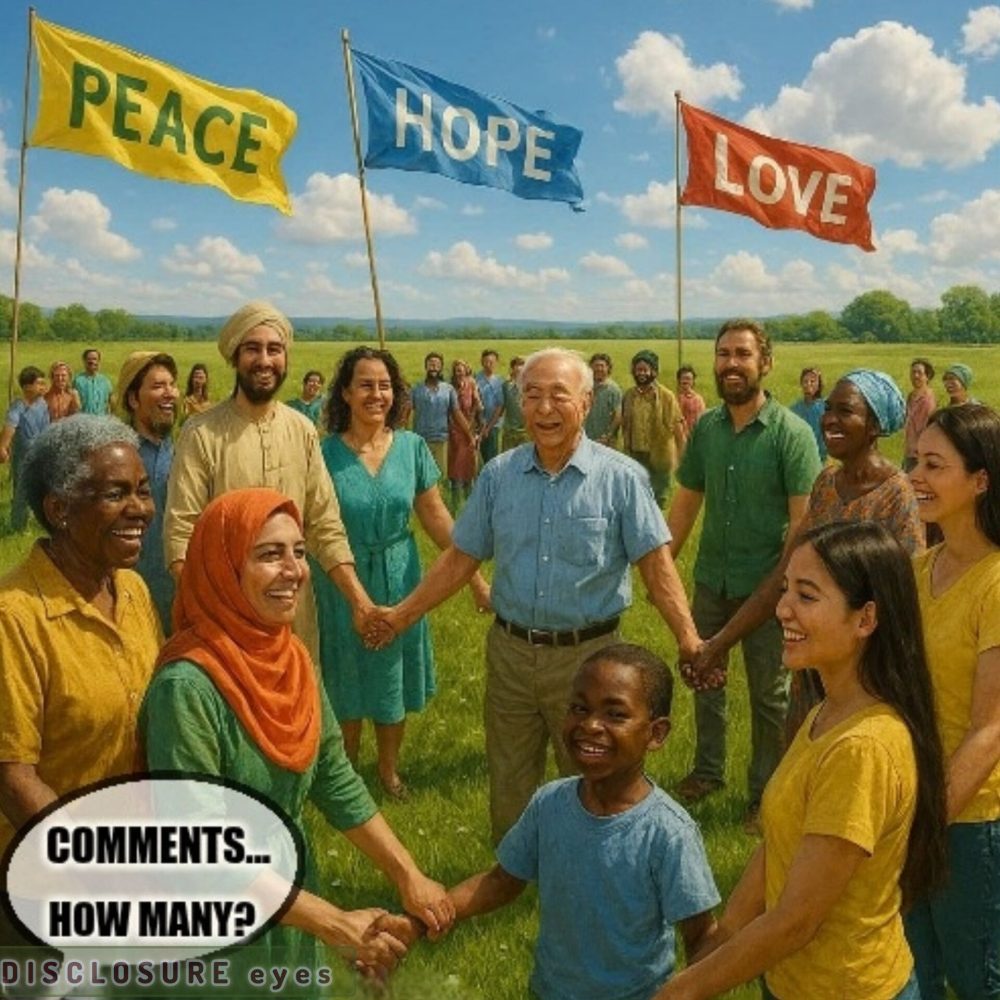
The ultimate outcome of this transformation is emphasized as a state where the “US all [are] stewards of ABUNDANCE & UNITY” [Image 1]. This abundance is not merely material wealth but a holistic state of well-being that arises from deep unity, justice, and the dismantling of oppressive systems. The vision prioritizes “collective rights and well-being over corporate control and social stratification”, ensuring that the benefits of a restored society are shared by all. This indicates that the desired “abundance” is not just material prosperity but a holistic state of well-being that arises directly from unity, justice, and the dismantling of oppressive systems. This connection links constitutional and social reform to a utopian vision where resources are equitably distributed, and human potential is unleashed, free from the “enslavement of economic struggle”. It suggests that the “end of the era” is not just political but marks a transition to a new, more prosperous and harmonious way of life for all, where true abundance is a product of collective flourishing.
The “Brave New World” and Uncharted Territories
The narrative boldly introduces more speculative, yet integral, elements of this expansive vision. It states that “The galactic contact and free energy disclosures that await us will forever change our understanding of the universe and our place within it”. These profound revelations are framed as part of the “incredible possibilities that lie ahead” as the nation navigates “uncharted territories” of human experience and cosmic understanding. This establishes a profound connection where achieving internal constitutional integrity and unity is presented as a necessary condition for humanity to responsibly handle advanced disclosures like “galactic contact” and “free energy.” It suggests that a fragmented, corporate-controlled society is not prepared for such profound truths, but a unified, sovereign populace is. This elevates the stakes of the constitutional movement beyond earthly concerns, suggesting it is a critical step towards humanity’s cosmic maturation and its readiness to engage with higher forms of existence and technology.
Shared Destiny and Collective Strength
This section concludes with a powerful message of unity and shared purpose, asserting, “We are the architects of our destiny, and together, we shall build a world that reflects the best of who we are and what we can achieve”. This reinforces the core belief that “we win when we are one”, highlighting the collective power to manifest this transformative future. The framing of “History and Complete Government Audits for the End of the Era” implies that the proposed changes are not incremental reforms but represent a fundamental, epochal shift in human history and governance. This suggests that the current system is not merely flawed but has reached its natural conclusion or a point of unsustainability, necessitating a complete overhaul rather than minor adjustments. This positions the movement as historically inevitable and profoundly significant, encouraging participation by framing it as being on the right side of history at a pivotal moment.
VIII. Conclusion: A Resolute Commitment to Peace, Justice, and Unity for All
This proposal calls for a renewed commitment to the foundational ideals of peace and justice, both within the United States and on a global scale. By embracing the guiding principle of peace through unity, envisioning a modern-day Jubilee that addresses contemporary injustices and inequalities, and strategically utilizing the constitutional framework of Article V, a future characterized by greater harmony, equity, and cooperation can be forged. The interconnectedness of these three guiding pillars—spiritual guidance, societal restoration, and constitutional reform—offers a comprehensive and potentially transformative pathway towards a more peaceful and just world for all.
The success of this vision demands collective attention, unwavering commitment, and resolute action. Citizens are encouraged to take their role seriously as stewards of democracy and to join in imagining a future where the Constitution is not merely a historical relic but a living document—a sacred compact for every individual. The promise is a world where peace reigns, justice prevails, and unity binds humanity together as one global community. This endeavor seeks to reclaim the spirit of the Organic Constitution and create a tapestry that truly reflects the pluralism and heart of this great land.
Redemption is among us. The time for a Constitutional Restoration is now. Through united effort, individuals can emerge free and radically transformed, ensuring that the ethos of liberty echoes from sea to shining sea. This is a call to draw from history, learn from the past, and act in the spirit of indispensable freedom, inviting every individual to contribute to writing this next, pivotal chapter in human history.

The Culmination: A Delightful Celebration Marking the End of World War III
The culmination of this profound transformation is envisioned as a delightful global celebration, marking the definitive end of World War III. Historically, significant peace treaties and the cessation of major conflicts have been commemorated with widespread celebrations, such as Armistice Day marking the end of World War I and various observances for the end of World War II. These events often involve moments of silence for reflection, followed by expressions of joy and unity. Such historical precedents provide a powerful template for envisioning a global celebration that transcends national boundaries and embraces a shared human triumph.
The United Nations, founded with the “overriding mission of saving succeeding generations from the scourge of war,” serves as a testament to humanity’s appreciation for international solidarity and shared humanity. Events like the “Global Unity Dinner” aim to encourage unity, peace, and understanding across different nations and communities, creating platforms for dialogue and celebrating diversity through music and dance. Transformational festivals also demonstrate how communities gather for “heart-opening connection, personal expansion and play,” fostering unity and transformation. These contemporary examples illustrate existing human capacities for collective joy and spiritual alignment, which can be amplified on a global scale. This celebration is not merely an end to conflict but a joyous affirmation of an “evolved human and planetary society” that has embraced its shared humanity and transcended its past divisions. It is a collective recognition of the “simple truth” that has led to everlasting peace and spiritual fulfillment.
These all pervasive, “ever-delightful celebrations” are not just a symbolic event, but the ultimate experiential manifestation of the collective achievement of everlasting life on Earth. It signifies the transcendence of the “fear of death and the unknown” through the realization of a perpetually flourishing, unified existence, where the “purpose of creation” has been collectively fulfilled. The celebration is the undeniable proof that the interpretive event catalyst and critical mass awakening have succeeded. It is the moment where the “concealment, shame, and contempt” have been definitively overcome, and the “simple truth” of unity and love is universally acknowledged and celebrated as the foundation of a new global reality. It represents a collective “Moksha” or “eternal communion with God” manifested on Earth.